
Your energy, your aging, and your resilience all start inside tiny structures called mitochondria. Here is how glutathione keeps them running, and the smartest way to raise your levels.
Why Glutathione Is the Guardian of Your Mitochondria
Deep inside almost every cell in your body sit tiny structures called mitochondria. Think of them as little power plants. They take the food you eat and the oxygen you breathe and turn it into the energy that keeps you alive.
When your mitochondria run well, you feel it. You have steady energy, a clear mind, and a body that recovers fast. When they struggle, the opposite happens. You feel tired, foggy, and older than your years. This is why mitochondrial health is one of the hottest topics in wellness right now.
Here is the part most people miss. Your mitochondria have a built in protector, and its name is glutathione. Glutathione and mitochondrial health are tied together so closely that you cannot really talk about one without the other. In this guide we will explain that link in plain words, show you what real medical research says, and cover the smartest way to give your mitochondria the glutathione support they need.
What Is Glutathione, in Simple Terms?
Glutathione is a small molecule your body makes on its own. Scientists call it a tripeptide because it is built from three amino acids: cysteine, glutamate, and glycine. That combination gives it real power.
Glutathione is often called the body’s master antioxidant. An antioxidant is anything that fights off harmful molecules called free radicals. Picture your cells as a busy city. Free radicals are the trash and pollution that pile up every day. Glutathione is the city’s waste crew. It grabs that harmful waste and turns it into something safer that your body can clear out.
Your body keeps a large supply of glutathione in your cells because it does so much. It protects your DNA, helps your liver detox, supports your immune system, and even recharges other antioxidants like vitamins C and E so they can keep working. But one of its most important jobs happens inside the mitochondria.
What Are Mitochondria and Why Do They Matter?
Mitochondria are the energy makers of your cells. Some cells have just a few. Hard working cells like those in your heart, brain, and muscles can hold thousands. Their main job is to produce a fuel called ATP, which is the energy your body burns for everything from thinking to walking to healing.
But there is a catch. Making energy is a messy process. As mitochondria turn fuel into ATP, they also create free radicals as a byproduct. Scientists call these reactive oxygen species, or ROS. A little bit is normal and even useful. Too many, and they start to damage the mitochondria themselves. This damage is called oxidative stress, and it sits at the root of aging and many chronic diseases.
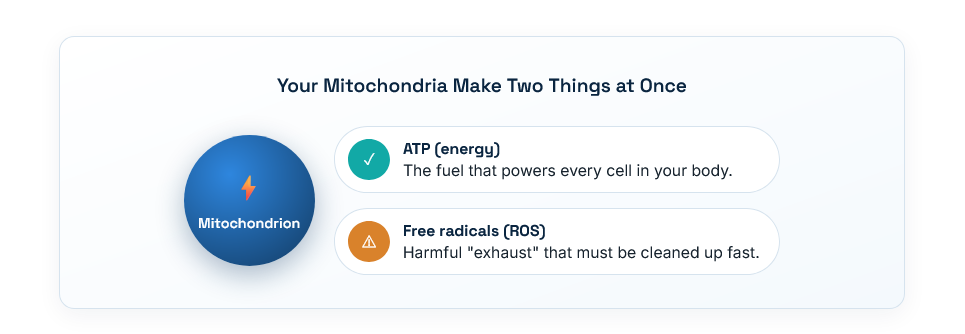
This is exactly where glutathione earns its keep. The glutathione that lives inside your mitochondria, known as mitochondrial glutathione, is the main cleanup crew for that harmful exhaust.
The Link Between Glutathione and Mitochondrial Health
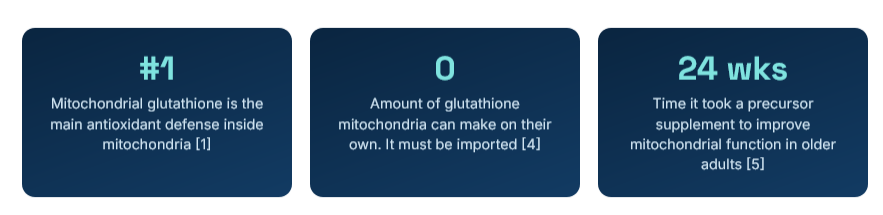
Researchers who study mitochondrial glutathione are clear on one thing. It is the main line of defense for keeping the inside of a mitochondrion balanced and healthy [1]. Here is how that plays out.
Glutathione neutralizes the “exhaust” from energy production
Every time your mitochondria make energy, they release free radicals. Mitochondrial glutathione steps in and clears out harmful molecules like hydrogen peroxide before they can hurt the cell [1]. Without enough of it, that damage builds up. Over time this hurts mitochondrial function, and struggling mitochondria make even more free radicals. It becomes a downward spiral.
Your mitochondria cannot make their own glutathione
This is a huge and often overlooked fact. Mitochondria are packed with glutathione, but they cannot produce it themselves. They have to import it from the rest of the cell through special doorways [4]. So if your overall glutathione levels drop, your mitochondria are among the first to feel the loss. Keeping your whole body’s glutathione topped up is how you protect these little power plants.
| Inside the cell | Healthy glutathione levels | Low glutathione levels |
|---|---|---|
| Free radicals | Cleared out quickly | Pile up and cause damage |
| Energy (ATP) | Steady and efficient | Drops as mitochondria weaken |
| Oxidative stress | Kept in balance | High and ongoing |
| Cell survival | Protected | More prone to early cell death |
What the Research Says About Glutathione and Mitochondrial Function
The link between glutathione and mitochondrial health is not just theory. It shows up again and again in medical studies.
Glutathione, mitochondria, and aging
As we age, our glutathione levels naturally fall and our mitochondria slow down. Researchers found that mitochondrial glutathione becomes more oxidized with age, meaning less of it is in the active, protective form [3]. In other words, the older we get, the less our cells are able to shield their own power plants.
One of the most exciting studies came out of Baylor College of Medicine. In a randomized clinical trial, older adults took a simple combination of glutathione building blocks (glycine and a cysteine source) for several months. The result was striking. The supplement corrected their glutathione shortage, lowered oxidative stress, and improved mitochondrial function, along with strength, walking speed, and other markers of aging [5]. People who took a placebo saw none of these gains.
The lead researcher made one point loud and clear, and it matters for the rest of this article. The people in the study did not take glutathione itself. They took the raw materials their bodies use to build it [5]. We will come back to why that difference is so important.
Mitochondrial glutathione and disease
When mitochondrial glutathione runs low, cells become fragile and more likely to break down. Scientists have linked this shortage to a long list of conditions, including Alzheimer’s disease, liver disease, and diabetic kidney problems [2][6]. The common thread is oxidative stress that overwhelms the mitochondria. Keeping glutathione levels healthy is one way the body defends against that damage.
How Glutathione Protects Your Mitochondria, Step by Step
Think of glutathione as a thermostat and a shield working together inside your cells. Here is the simple version of what it does around your mitochondria.
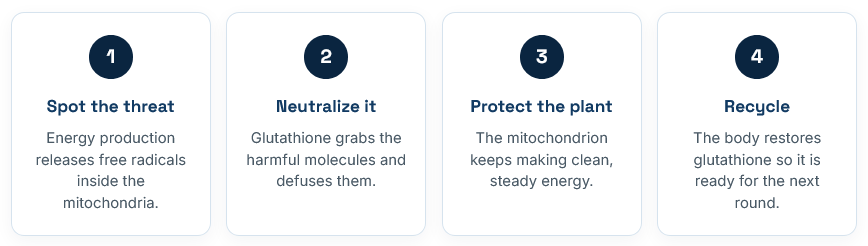
This cycle runs millions of times a second across your body. As long as you have enough glutathione, your mitochondria stay protected. The trouble starts when your levels fall.
What Drains Your Glutathione and Hurts Mitochondrial Health
Modern life is hard on your glutathione supply. Everyday habits and stressors can lower it, which leaves your mitochondria exposed. Here are the biggest culprits.
| What lowers glutathione | Why it matters for your mitochondria |
|---|---|
| Aging | Natural production drops year after year, leaving power plants less protected. |
| Poor diet | Low intake of the building blocks your body needs to make glutathione. |
| Smoking and alcohol | Both flood the body with free radicals that use up your supply. |
| Chronic stress and poor sleep | Push oxidative stress higher and drain your reserves faster. |
| Pollution and toxins | Force your cells to spend glutathione on cleanup and detox. |
| Illness and inflammation | Burn through glutathione quickly during the immune response. |
The good news is that you have real control here. By protecting and rebuilding your glutathione levels, you give your mitochondria a fighting chance.
How to Support Glutathione and Mitochondrial Health Naturally
You can help your body in two ways. First, cut back on the drainers above where you can. Second, and this is the key, give your body the raw materials it needs to make more glutathione. But how you do that matters a lot.
The problem with taking glutathione directly
It seems obvious. If you want more glutathione, just swallow glutathione, right? Not quite. Your body does not really want to receive finished glutathione. It wants to build its own using its natural system. Many glutathione pills are broken down during digestion before they can help much. IV drips and injections can raise levels for a short time, but they are invasive, costly, and hard to keep up.
Precursors: the smarter way to raise glutathione
This is where the science gets interesting. A precursor is a building block your body uses to make something. Glutathione precursors are the amino acids your cells assemble into fresh glutathione. Remember the Baylor aging study? Those older adults did not take glutathione. They took precursors, and their bodies built the rest [5].
The most important precursor is cysteine. It is the hardest one for your body to get and it acts as the limiting factor in glutathione production. If you want to raise your glutathione for better mitochondrial health, delivering usable cysteine is the goal. And this is exactly where one clinically studied product stands apart.
Immunocal: A Studied Way to Raise Glutathione for Mitochondrial Support
Immunocal is a patented, undenatured whey protein made to deliver a special form of cysteine that your cells can use to build glutathione naturally. That last part is the whole point. It does not hand your body finished glutathione. It hands your body the raw material and lets your own cells do the work, which is the approach the research keeps pointing to.
What makes Immunocal different is how it is made. Regular whey proteins lose their power through heat and heavy processing. Immunocal is prepared gently so it keeps the fragile bonds between cysteine molecules intact. Researchers note that plain L cysteine on its own does not raise glutathione well, but the bonded cystine in undenatured whey survives digestion, reaches your cells, and feeds glutathione production [7].
This is not just marketing. Immunocal has real, published research behind it:
- In studies, undenatured whey protein like Immunocal raised glutathione levels and supported muscle strength in older adults [7].
- In a brain injury model, animals given Immunocal beforehand held on to far more of their protective glutathione, and showed better memory and movement afterward [8].
- A pilot study in people with the skin condition psoriasis used Immunocal as a glutathione precursor and saw symptom improvements [9].
How the main ways to raise glutathione compare
| Method | How it works | The catch |
|---|---|---|
| Glutathione pills | Swallow finished glutathione | Mostly broken down in digestion |
| Liposomal glutathione | Wraps glutathione in fat for absorption | Results can be short lived and uneven |
| IV drips or injections | Sends glutathione into the blood | Invasive, costly, hard to sustain |
| Precursor whey (Immunocal) | Delivers usable cysteine so your body builds its own | Backed by human studies, taken by mouth |
Frequently Asked Questions About Glutathione and Mitochondrial Health
Can raising glutathione really improve mitochondrial function?
Research suggests it can. In a randomized clinical trial, older adults who took glutathione precursors for several months saw real improvements in mitochondrial function along with lower oxidative stress. Because mitochondria rely on glutathione to clean up the free radicals they produce, keeping levels healthy supports how well they work.
Why can't my mitochondria just make their own glutathione?
They simply do not have the tools for it. Mitochondria hold a large supply of glutathione, but they have to import it from the rest of the cell through special carriers. That is why your whole body's glutathione status matters so much for mitochondrial health.
Is it better to take glutathione or a glutathione precursor?
Precursors have the stronger case. Finished glutathione is often broken down before it can be used, while precursors like the cysteine in undenatured whey give your cells the raw material to build fresh glutathione on their own. The clinical research on aging used precursors, not straight glutathione.
Does glutathione decline with age?
Yes. Glutathione levels tend to fall as we get older, and the glutathione inside our mitochondria becomes less active. This is one reason many older adults look at precursor supplementation to help restore what time takes away.
What lowers my glutathione the fastest?
Smoking, heavy alcohol use, chronic stress, poor sleep, pollution, illness, and a nutrient poor diet all drain glutathione. Each one raises oxidative stress, which forces your cells to spend their glutathione faster than they can rebuild it.
Give Your Mitochondria What They Really Need
Immunocal is the only patented glutathione precursor of its kind, made to help your body raise its own glutathione naturally. Backed by peer reviewed research and trusted for immune and cellular health.
Shop Immunocal ProductsThe Bottom Line
Glutathione and mitochondrial health go hand in hand. Your mitochondria power everything you do, but every burst of energy also creates harmful free radicals. Glutathione is the master antioxidant that clears that damage and keeps your cellular power plants running strong. Since your mitochondria cannot make glutathione on their own, and since your levels fall with age and daily stress, giving your body the right building blocks is one of the smartest things you can do for lasting energy and healthy aging. The research points to precursors, not finished glutathione, as the way forward, and Immunocal is a clinically studied way to deliver exactly that.
References
- Ribas V, García-Ruiz C, Fernández-Checa JC. Mitochondrial glutathione: features, regulation and role in disease. Antioxidants (MDPI), 2020. mdpi.com/2076-3921/9/10/909
- Mitochondrial glutathione in cellular redox homeostasis and disease manifestation. PMC, 2024. ncbi.nlm.nih.gov/pmc/articles/PMC10816320
- Age-associated oxidation of mitochondrial glutathione. PubMed. pubmed.ncbi.nlm.nih.gov/8641567
- Marí M, et al. Mitochondrial glutathione: transport from the cytosol. ScienceDirect, 2012. sciencedirect.com/science/article/abs/pii/S0304416512003042
- Kumar P, et al. Supplementing Glycine and N-Acetylcysteine (GlyNAC) in older adults improves glutathione deficiency, oxidative stress, mitochondrial dysfunction and aging hallmarks: a randomized clinical trial. J Gerontol A Biol Sci Med Sci, 2023;78(1):75-89. academic.oup.com/biomedgerontology/article/78/1/75/6668639
- Mitochondrial glutathione, a key survival antioxidant. PMC. pmc.ncbi.nlm.nih.gov/articles/PMC2821140
- Effect of cysteine-rich whey protein (Immunocal) supplementation on muscle strength in non-frail elderly subjects: a randomized, double-blind controlled study. PMC. pmc.ncbi.nlm.nih.gov/articles/PMC12877478
- Immunocal preserves brain glutathione and improves outcomes in a traumatic brain injury model. PMC. pmc.ncbi.nlm.nih.gov/articles/PMC6211803
- Psoriasis improvement in patients using glutathione-enhancing, nondenatured whey protein isolate: a pilot study. J Clin Aesthet Dermatol, 2015. jcadonline.com
This article is for general education only and is not medical advice. Immunocal is a glutathione precursor, not a glutathione supplement, and is not intended to diagnose, treat, cure, or prevent any disease. Talk with your healthcare provider before starting any supplement, especially if you take other medications.